
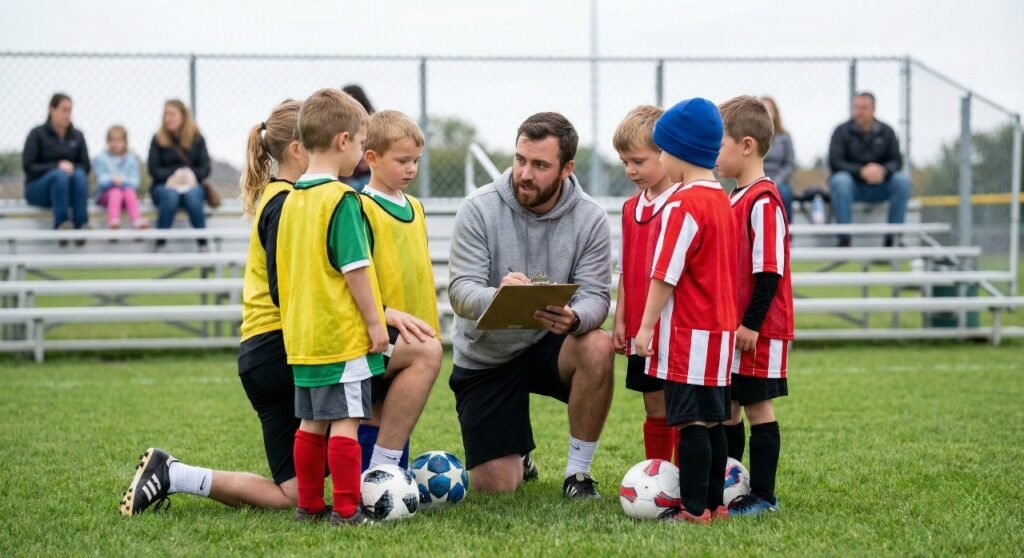
Soccer is more than just running after a ball. It helps kids build strength, confidence, focus, and a sense of teamwork. With the right support, children aged 5–10 can move from casual kicking in the backyard to playing with real skill and understanding.
This guide walks through the key soccer skills kids should work on, how to train them in a fun and simple way, how parents can support at home, and how 416 Soccer’s training program helps youth players improve faster and stay in love with the game.
Core Soccer Skills Kids Need to Improve
For a child to really “improve in soccer,” they need more than one good move. Progress comes when several skills grow together.
Essential Soccer Skills and Attributes
Kids should work on:
- Dribbling and close control
- Passing and receiving
- Shooting and finishing
- Defending and basic positioning
- Agility, speed, and coordination
- Game awareness, decision making, and teamwork
- Confidence, discipline, and a positive mindset
These areas connect to each other. Better dribbling gives kids confidence. Good passing helps them feel part of the team. A stronger mindset helps them handle mistakes and keep going.
Skill by Skill – How Kids Can Improve in Soccer
Dribbling
Dribbling is usually the first skill kids fall in love with. It helps them feel in control of the ball instead of chasing it.
How to practice:
- Encourage your child to use both feet, not only their strong foot.
- Ask them to keep the ball close to their feet with small, gentle touches.
- Set up cones, water bottles, or toys and let them weave through in the yard or park.
Parent tip:
Turn dribbling into a game. Time how fast they can complete a simple course, then let them try to beat their own time. Praise effort and improvement, not just speed.
Passing
Passing turns individual players into a real team. It helps kids share the ball, stay involved, and learn that soccer is not a one-person show.
How to improve:
- Aim passes at a partner’s feet, not just in their direction.
- Start with the inside of the foot for control, then add outside-of-the-foot passes.
- Mix short passes for quick play and slightly longer passes to switch sides.
Parent tip:
You can keep it very simple:
- Pass back and forth in the yard.
- Use a wall so the ball comes back to them.
- Put two markers on the ground as a “gate” and ask your child to pass through it.
Shooting
Shooting is exciting for kids. Scoring builds belief and makes them want to practice more.
How to improve:
- Practice with both feet so they can shoot from either side.
- Focus on accuracy first: hitting a small target is better than kicking as hard as possible.
- Vary the angle and distance to copy real game situations.
Parent tip:
Use a small net, cones, or a marked spot on a fence. Ask your child to “pick a corner” or hit a specific area. Celebrate good technique and smart attempts, not just goals.
Defending and Positioning
Defense teaches kids about responsibility and teamwork. Good positioning makes it easier to win the ball back and protect the goal.
How to improve:
- Show them a ready stance: knees bent, body low, on their toes, facing the attacker.
- Explain that they should stay between the opponent and the goal.
- Use small-sided games so they learn to mark players, track runs, and time tackles.
Parent tip:
Talk about defending as “helping the team.” Praise your child when they run back, stay with their player, or win the ball fairly, not only when they score.
Agility, Speed, and Coordination
Soccer is full of quick changes: turn, stop, sprint, recover. Agility and coordination make these movements smooth instead of clumsy.
How to improve:
- Set up simple cone or object courses to change direction around.
- Add short sprints and stop-start drills.
- Combine footwork with the ball, like dribbling through cones then sprinting to a line.
Parent tip:
Make it playful: obstacle courses, races, or “follow the leader” games. When it feels like play instead of “work,” kids naturally get faster and more coordinated.
Game Awareness, Decisions, and Teamwork
Soccer is a thinking game. Knowing when to pass, move, or shoot matters as much as knowing how to do it.
How to improve:
- Play small-sided games (3v3 or 4v4) to give kids more touches and more decisions.
- Encourage them to talk on the field: call for the ball, warn teammates, and support each other.
- Use simple games where they must choose quickly between passing, dribbling, or shooting.
Parent/Coach tip:
Praise smart decisions, not only big goals. A good pass to an open teammate, or choosing to keep the ball instead of forcing a shot, is a win too.
Confidence, Discipline, and Mental Toughness
Kids improve faster when they feel safe to try, make mistakes, and try again. Mindset is the glue that holds all the other skills together.
How to build this:
- Keep practice regular and short rather than rare and long.
- Celebrate small wins: a better first touch, a stronger pass, a brave tackle.
- Remind them that mistakes are part of learning, not a reason to feel ashamed.
- Focus on enjoying the game and seeing progress, not just on the score.
Parent/Coach tip:
Help your child set small goals such as:
- “Today I’ll try using my weaker foot 5 times.”
- “Today I’ll call for the ball when I’m open.”
Praise the effort to reach these goals, even when everything isn’t perfect.
Why 416 Soccer Helps Kids Improve Faster
Age-Appropriate Training for Ages 5–10
416 Soccer is designed specifically for young players, not just older drills scaled down. Training focuses on:
- Physical foundations: agility, balance, speed, and basic endurance
- Technical skills: dribbling, passing, shooting, first touch, and defending
- Tactical basics: where to move, how to support teammates, when to pass or hold the ball
- Mindset: confidence, resilience, and love for the game
Sessions use games and simple drills so kids learn naturally while they play.
Coaches Who Understand Kids
Coaches at 416 Soccer know how to teach children, not just how to play themselves. They:
- Demonstrate clearly instead of over-explaining
- Give simple, positive feedback kids can act on
- Treat mistakes as chances to learn, not reasons to criticize
This kind of environment helps kids relax, try new things, and actually absorb what they’re learning.
Small-Sided Games for Real Improvement
Small-sided games, such as 3v3 or 4v4, are a core part of 416 Soccer’s sessions. These games:
- Give each child more touches on the ball
- Force more decisions per minute (pass, move, shoot, defend)
- Build teamwork and communication in a simple, clear setting
Kids learn faster in these formats than in crowded full-sized matches where they rarely touch the ball.
Fitness, Healthy Habits, and Life Skills
Regular training with 416 Soccer also supports kids beyond the field:
- They build cardio fitness, strength, and coordination.
- They develop habits of regular activity, which support long-term health.
- Being in a team grows communication, cooperation, discipline, and respect.
These are life skills they carry into school, friendships, and family life.
Help Your Child Improve in Soccer
If you want your child to improve in soccer, build real skills, and enjoy training in a positive environment, 416 Soccer is ready to help.
Kids at 416 Soccer learn to:
- Control the ball with confidence
- Pass, move, and think like part of a team
- Handle mistakes and keep trying
Enroll your child with 416 Soccer today and give them a place to grow as a player and as a person.
FAQ – Improving in Soccer for Kids
Start with dribbling, passing, and shooting. Add defending, agility, and teamwork as they grow. Consistent practice and a positive mindset make the biggest difference.
Practice with both feet, keep the ball close with small touches, and use cones or objects as obstacles. Timed challenges help keep it fun.
Work on accurate passes to a partner’s feet or to a marked target. Use both feet and repeat simple drills with a partner or against a wall.
Focus on accuracy first. Aim for specific targets or corners of the goal and practice shooting with both feet from different angles.
Teach them to stay low and balanced, keep their body between the opponent and the goal, and practice defending in small-sided games.
Short sprints, agility drills, and footwork exercises with and without the ball all help. Obstacle courses and relay races are great for younger kids.
Encourage effort, not perfection. Talk about mistakes as part of learning, and keep practice enjoyable so they stay motivated.
Age-appropriate drills, individual attention, small-sided games, and a positive coaching style help kids improve quickly while staying confident and happy.
Through passing drills, group games, and small-sided matches where kids must communicate, support each other, and share the ball.
Soccer builds fitness, coordination, confidence, discipline, and social skills, and it helps kids learn how to work with others toward a common goal.